Elves
The Ballad of the Last DragonElves are a people marked by cultural loss, political exclusion, and endurance. In the narrative, they are not merely remnants of an ancient magical race: they are a living community whose language, memories, family ties, and claims to land have been attacked by institutions that turn inherited fear into law. Their history gives the story its clearest account of how a population can be transformed from a neighboring people into a permanent object of suspicion, while their survival demonstrates that identity can persist even when its archives, temples, rights, and homes are destroyed.
Identity and Cultural Inheritance
Elves are associated with a much older civilization whose power has become the subject of human legend. Human and dwarven histories present the ancient elves as beings of extraordinary power and malice, while the present-day elves possess no clear continuation of that supposed power. Stories claim that an elf can control human thoughts through speech or drink the blood of human children, but the narrative presents these accusations as absurd fabrications rather than reliable descriptions of elven nature. Their political force lies not in their truth but in their repetition: tales that once seemed too irrational to matter gradually become the emotional foundation for persecution.
The surviving elven culture is especially vulnerable because much of its written record was destroyed. During the conflict remembered by elves as The Great Loss, elven texts and sacred structures were ruined along with other buildings of elven design. The destruction did not erase elven history completely because it continued through spoken word. Knowledge of the Ancient Elvish alphabet and the old history survives in family transmission, including the education passed down by Sylvaine Abelan’s father. Within that context, teaching the alphabet is itself an act of resistance: preserving knowledge becomes a quiet refusal to accept the conquerors’ version of the past as the only history that remains.
Elven identity also appears through material culture. An elven-made necklace is rare in the Western Isles and is treated as a luxury available mainly to the elite, partly because artisans from Smarighad were forced into hiding. Neith’s necklace carries this history in portable form. Its design recalls the similar necklace once worn by Sylvaine Abelan’s aunt Elothwyn, linking displaced generations through an object that escaped destruction even when families, settlements, and public institutions did not.
Persecution and Legal Exclusion
The present condition of the Elves grows out of a long political process rather than a single outbreak of hatred. During The Unification, Hawthok allied with humans, while dwarves were divided; dwarves who fought were rewarded with land and minor titles in Targgein. The resulting human and dwarven historical tradition cast those allied peoples as heroes and the ancient elves as enemies. Although a tenuous peace lasted for more than a century, distrust accumulated until the earlier war could be revived as a permanent explanation for fear.
The first visible pressure came through ordinary disputes that were settled unequally. Town magistrates could favor a human’s word over an elf’s because elves were forbidden to speak in official councils. The prohibition was justified by the possibility that elves might use magical speech to sway judgment, converting a superstition into a restriction on legal participation. Accusations then gave the prejudice a more intimate and opportunistic form: an elf could be blamed for a human’s sexual decision or for an unfavorable bargain, with supposed magic replacing evidence and personal responsibility.
The raids followed this preparation. Elves lost the right to hold titles, including land. Those who refused to surrender their property and move into cities—where they would face searches and curfews—were branded fugitives. The state did not simply withdraw protection; it organized their vulnerability. Humans could pay a taxation fee for a license to hunt fugitive elves for sport, and some hunters displayed elven ears on chains as trophies. The system therefore made elven bodies both legally exposed and socially consumable, treating their persecution as an authorized activity rather than an aberration.
Displacement and Survival
For Elves, land is more than property. Memories and generations of ancestors establish a claim that legal documents can remove but cannot make meaningless. Once titles were stripped away and flight became necessary, the old territory ceased to function as home even though it remained bound to elven memory. Those able to leave sought safer shores, but escape itself was restricted by cost and transport: few vessels were willing to carry elves to the continent, and passage was expensive.
Sylvaine Abelan’s departure gives this collective displacement its sharpest personal measure. Her family could afford only one boarding pass, forcing her to leave her parents behind while knowing that imprisonment, or something worse, awaited them. The choice is not presented as a free migration or an adventurous beginning. It is a division of the family imposed by persecution, in which survival for one person requires accepting danger for those who cannot leave.
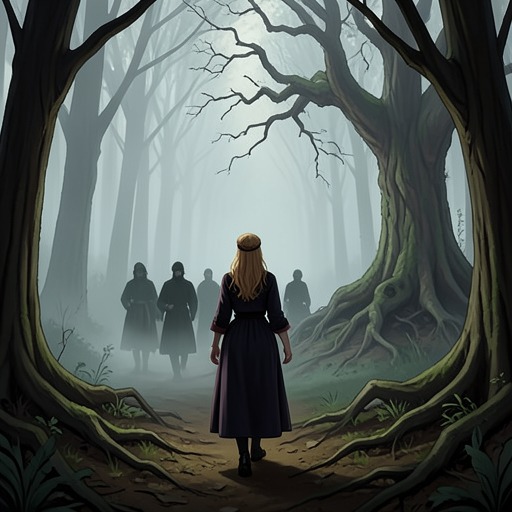
The remembered raids also explain the emotional geography of Sylvaine Abelan’s childhood. Smarighad had once been a place of immense forests, towering trees, and giant oyster mushrooms broad enough for children to climb. That magical landscape became a place of concealment and fear as friends, neighbors, and familiar members of the community disappeared without farewells or explanations. The contrast between free childhood play and hiding under threat shows how persecution changes not only public rights but the meaning of ordinary space. A forest that once promised freedom becomes a place where disappearance is expected.
Safety after displacement remains conditional. In the new setting, hatred and mistrust are less blatant, and Sylvaine Abelan does not fear for her life merely by walking along the road. Yet she checks her cap before every performance to ensure that her ears remain covered. Concealment is therefore a survival practice, not a resolved identity question. The absence of immediate violence cannot be mistaken for equality when the possibility of renewed persecution still governs how an elf moves through public life.
Relations with Other Peoples
The treatment of Elves differs sharply from the social acceptance granted to Dwarves. A barkeep of dwarven descent can participate in easy tavern camaraderie, a condition connected to the dwarven alliance with humans during The Unification and the rewards granted afterward. An elven barkeep, by contrast, would likely encounter tension and vaguely hostile threats from rowdier drinkers. This contrast reveals that prejudice is not an undifferentiated fear of nonhumans: it is historically produced, politically maintained, and selectively softened for groups incorporated into the victorious order.
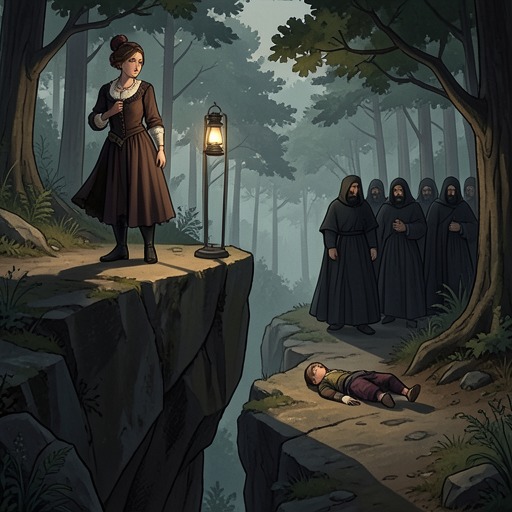
The threat of suspicion follows Elves even when no evidence exists. After three men disappear, Sylvaine Abelan fears that newcomers will be blamed and that she will be accused first because any incident can be used to portray elves as the monsters of ancient tales. Her fear is rational within the established system. Neith and Cadoc burn the bodies to prevent corpse-eaters from being drawn to them, then leave the men’s shoes and valuables beside a lake so their deaths will appear to have resulted from drowning. The deception protects the group, but it also demonstrates the pressure under which Elves live: the danger is not limited to direct assault, because suspicion can make an elf the convenient explanation for any unexplained event.
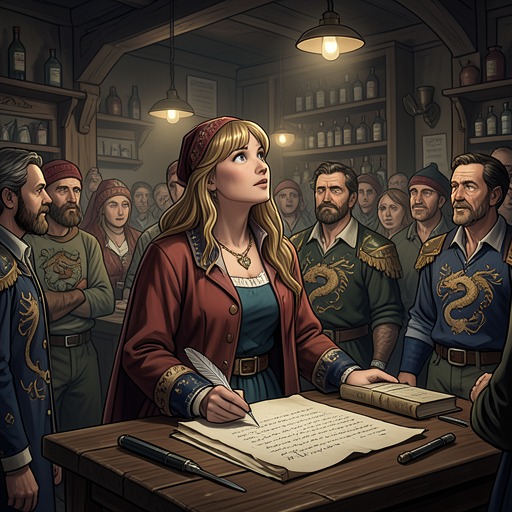
Objects and gestures can nevertheless create alliances across those divisions. An elven woman serves Sylvaine Abelan a drink while keeping her ears hidden beneath a patchwork kerchief, making visible the shared discipline of concealment. Neith later gives Sylvaine Abelan her elven necklace, explaining that it once represented her mother’s disapproval but came to signify the courage to follow a true path. In Sylvaine Abelan’s hands, its resemblance to Elothwyn’s necklace turns a personal gift into a bridge between elven histories and chosen companionship.
Recovery, Rescue, and Narrative Significance
The story does not resolve the condition of the Elves through a simple restoration of the lost past. Instead, recovery begins through memory, art, mutual protection, and movement across borders. Sylvaine Abelan adds the Arachnida fight to her ballad, including Aeron Fowler’s attack with river rocks and his refusal to accept defeat. The same event changes depending on who tells it: when Sylvaine Abelan imagines herself, she sees fear and weakness, while the ballad can preserve courage in another form. Elven storytelling thus becomes a means of resisting the identities imposed by persecutors and by trauma itself.
The surviving prayer stone reinforces the material persistence of a nearly erased sacred world. In a hidden room containing barrels of black powder, the stone remains in a glass case after the goddess’s temples and other elven structures were destroyed more than a century earlier. Its survival is not evidence that the old order has returned, but it makes absence tangible. A single sacred object can carry the memory of an entire religious and architectural culture that official violence attempted to eliminate.
The final movement toward rescue gives the Elves a future-oriented political possibility. Neith joins Cinna’s crew aboard The Sea Harpy, which is assembling an elite extraction team for operations in neighboring countries, especially Smarighad. When Sylvaine Abelan understands that the mission is to rescue elves, the history of flight is reframed: elves are no longer only people escaping a collapsing homeland, but people whom others are deliberately trying to bring to safety. The rescue remains dangerous and does not undo the losses of The Great Loss, the raids, or the families separated by exile. It nevertheless changes the direction of the narrative from survival by concealment toward solidarity organized as action.
Through the Elves, the novel connects personal memory to institutional violence. Their destroyed texts, forbidden speech, confiscated land, hunted fugitives, hidden ears, preserved jewelry, and planned rescues form one continuous history. Fear is shown as a force capable of making monsters of ordinary people, but the Elves’ endurance answers that process with another kind of inheritance: spoken history, cultural memory, reciprocal care, and the insistence that displacement has not erased belonging.